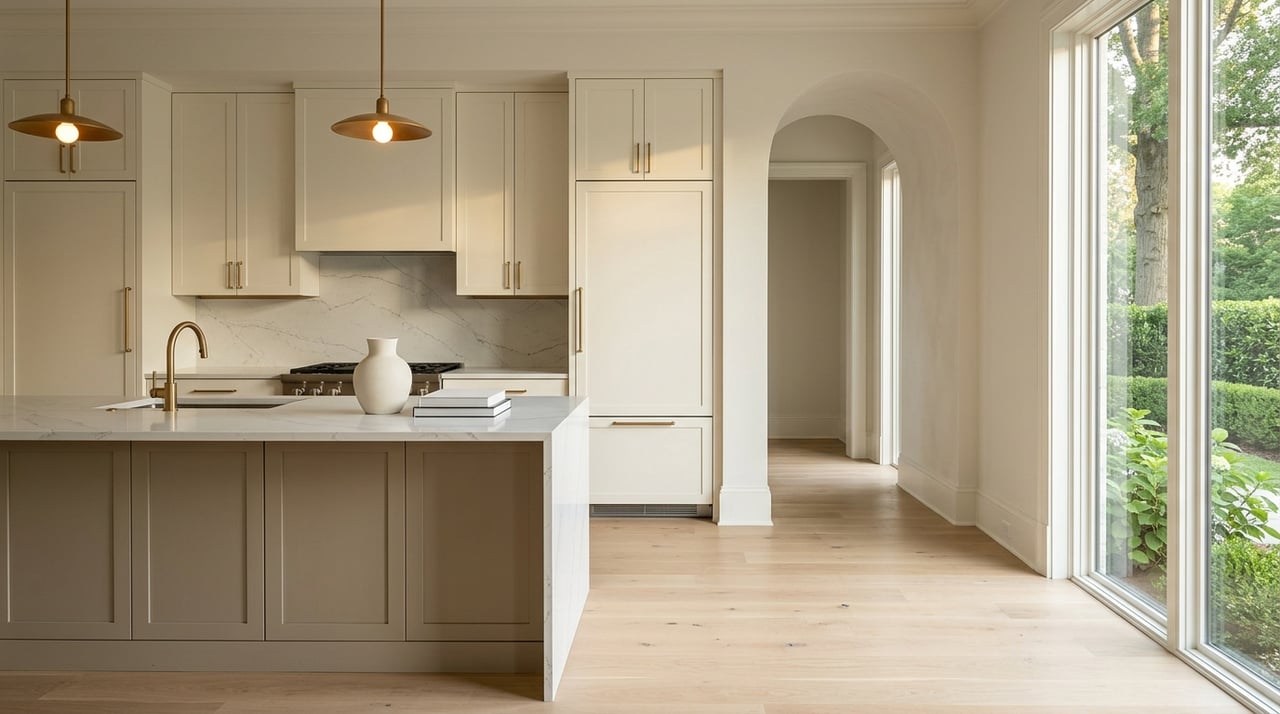
Wondering whether to reimagine your current home or make a strategic move to something better suited to your next chapter? In Charlotte’s luxury market, that choice is rarely just about taste. It is about timing, resale math, lifestyle fit, and how much disruption you want to take on. If you are weighing a major renovation against a move-up purchase, this guide will help you think through the numbers and the practical tradeoffs with more clarity. Let’s dive in.
Charlotte luxury owners face a real fork in the road
Charlotte is not in a frozen market, and it is not in a runaway frenzy either. In March 2026, the region had about 10,900 homes for sale and roughly three months of supply, while Mecklenburg County sat at about 2.7 months and the City of Charlotte at about 2.9 months. Sellers were still receiving about 95.6% of original list price, which points to a market that remains competitive when a home is well positioned.
That matters if you own a luxury property and feel torn between improving what you have and pursuing something new. Inventory has improved, but choices are still not abundant in many high-demand segments. At the same time, spring activity has been accelerating, so both buyers and sellers are making moves with intention.
Mortgage rates also shape the decision. Freddie Mac’s April 30, 2026 survey put the 30-year fixed rate at 6.30%, which means financing costs remain part of the equation for anyone considering a move. For many luxury homeowners, the question is less about whether a move is possible and more about whether it creates a better long-term fit than a renovation.
Why remodeling feels appealing
There is a reason many Charlotte homeowners start with the idea of remodeling. If your address, lot, and overall setting still work beautifully for your life, upgrading the home you already love can feel more efficient than starting over. You may also want to avoid the logistics of listing, buying, packing, and moving.
Remodeling can be especially attractive when the changes are visible, manageable, and tied to everyday enjoyment. Nationally, Americans spent an estimated $603 billion on remodeling in 2024, and 46% of REALTORS® said buyers are less willing to compromise on home condition than they were before. That makes presentation and upkeep more important, especially if resale may be on the horizon.
Still, not every renovation delivers the same return. In Charlotte, the data show a meaningful difference between smart updates and major upscale expansions.
Charlotte remodel ROI is not one-size-fits-all
Charlotte-specific cost-versus-value data suggest that smaller exterior or cosmetic projects often recover more at resale than large luxury additions. That is good news if your home needs refinement rather than a full reinvention. It is less encouraging if you are considering a major upscale project and hoping resale will justify the spend.
Here is what Charlotte’s numbers show for selected projects:
| Project | Average Cost Recouped at Resale |
|---|---|
| Garage door replacement | 189.1% |
| Steel entry door replacement | 166.6% |
| Manufactured stone veneer | 141.6% |
| Fiber-cement siding | 100.9% |
| Minor kitchen remodel | 87.3% |
| Upscale bath remodel | 42.5% |
| Upscale kitchen remodel | 35.9% |
| Upscale primary suite addition | 20.9% |
For luxury homeowners, this is often the turning point in the conversation. If you are replacing a tired entry, refreshing curb appeal, or making a minor kitchen update, the economics can be sensible. If you are planning an upscale kitchen overhaul or a large primary suite addition, the resale recovery in Charlotte is much lower.
On the averages in this report, the unrecovered spend is significant. An upscale bath remodel leaves about $43,863 unrecovered, an upscale kitchen remodel about $96,443, and an upscale primary suite addition about $249,913. If the renovation is for your personal enjoyment over many years, that may be acceptable. If you may move in the near future, it deserves a closer look.
Timing risk matters more than many owners expect
Budget is only part of the remodel story. Timing can be just as important, especially if your move horizon is short. NAR found that 31% of remodeling projects took more time than planned, and Harvard’s 2025 housing report noted that skilled-trade shortages continue to constrain labor.
In practical terms, that means a major renovation may not finish when you want it to. If your plans depend on a work relocation, a family timing shift, or a preferred selling window, delays can create stress and force compromises. A simple cosmetic refresh is easier to control than a large structural or high-design addition.
Charlotte’s seasonal rhythm adds another layer. Canopy reported that late fall and winter usually slow down, while spring brings renewed activity and more competition. By March 2026, more than 4,700 homes were already going under contract regionwide, which shows how quickly momentum can build.
When moving up may be the smarter play
Moving often makes more sense when your current home has a fundamental mismatch that a renovation cannot solve efficiently. That could mean the layout no longer fits your daily life, the lot is not what you want, the systems are aging, or you want a more turnkey property with a different design standard. In those cases, a move is not just a financial decision. It is a lifestyle upgrade.
The broader market gives many repeat buyers room to act. NAR reports that all-cash purchases averaged 26% of sales, the median down payment was 19% overall and 23% for repeat buyers, and 54% of repeat buyers used proceeds from a previous home to help finance the next one. For equity-rich homeowners, that can make a move-up strategy more practical than it first appears.
Charlotte also continues to show active demand in move-up areas. Waxhaw and Matthews averaged 6.7 showings per listing, while Huntersville and Fort Mill also drew solid traffic. If you are considering a move into a different submarket, that demand supports the idea that desirable homes are still attracting attention.
New construction is also worth considering for some luxury buyers. NAR says new-home purchases rose to 16%, and buyers often chose new construction to avoid renovations or major repair issues and to customize design features. If your real goal is a fundamentally different floor plan, newer systems, or a more turnkey finish, moving may align better with what you actually want.
Property taxes should be part of the conversation
For higher-end purchases, carrying costs deserve a place in the decision. Mecklenburg County’s FY2026 property tax rate is 49.27 cents per $100 of assessed value, and the county notes that the total bill can also include municipal tax. At that county rate alone, the annual tax is about $9,854 on a $2 million assessment and about $14,781 on a $3 million assessment.
That does not mean you should avoid moving up. It means the monthly picture should be evaluated with the same care as design preferences and purchase price. In the luxury space, the right move is often the one that feels beautiful to live in and sustainable to carry.
School assignment and future planning matter
If school assignment is part of your move decision, verify the details before assuming a property will serve the same assignment over your full ownership period. Charlotte-Mecklenburg Schools says magnet schools have no attendance boundary, while program choice schools do. The district currently offers 16 choice programs across 71 schools in three transportation zones.
CMS also says its Board conducts a comprehensive district-wide review every four years and may make localized changes sooner. Step Two of the current review begins in fall 2026 and includes programmatic and boundary adjustments. For families, that makes confirmation and timing especially important when comparing a remodel with a move.
The key is to stay factual and current. A home can be wonderful for your lifestyle while still requiring careful verification on assignment details. That kind of due diligence matters just as much as square footage or finishes.
A practical framework for your decision
If you are trying to decide what to do next, a simple framework can help you cut through the emotion and focus on fit.
Remodel if the location still wins
A remodel often makes sense when your current location feels irreplaceable. If the lot, setting, and daily convenience still work well, and the needed updates are mostly cosmetic or exterior, staying put may be the more elegant choice.
Charlotte data especially support practical improvements like doors, siding, curb appeal, and modest kitchen refreshes. These projects can improve your enjoyment now and help your home present well later.
Move if the home needs a full rethink
A move-up strategy is often stronger when the layout is fundamentally wrong or the renovation wish list includes major upscale additions. If the solution requires an expansive kitchen rework, a new primary suite addition, or a major footprint change, the resale recovery may not support the investment.
This is also true if you want a different submarket, more privacy, a larger lot, newer construction, or a more turnkey lifestyle. In that case, moving may solve multiple problems at once in a cleaner, more efficient way.
Consider a hybrid strategy
Sometimes the best answer is not immediate. A hybrid approach can work well if you make high-ROI repairs and presentation updates now, then reassess after the next market cycle. That can help you preserve flexibility while improving your home’s livability and market readiness.
This approach is especially useful if your timeline is still taking shape. It lets you avoid overspending on low-recovery projects while keeping the door open to a future move.
The luxury question is really about alignment
At the high end of the market, this decision is rarely just about resale percentage. It is about how you want to live, how much complexity you want to manage, and whether your current home still supports your next season well. The right answer is the one that aligns your numbers, your timing, and your lifestyle.
In Charlotte, today’s market gives you options. Inventory is improving but still measured, buyer demand remains active, and the data clearly favor selective updates over major upscale additions when resale is a concern. If you approach the choice with a clear framework, you can make a confident decision instead of an expensive reaction.
If you are weighing whether to refine your current home or curate a move to something more fitting, Whitley Stewart offers white-glove guidance for Charlotte luxury buyers and sellers who want strategy, discretion, and a beautifully managed experience.
FAQs
Should Charlotte luxury homeowners remodel before selling?
- It depends on the scope of work. Charlotte data show smaller exterior and cosmetic projects often recover more at resale than major upscale additions.
What remodeling projects have the best resale value in Charlotte?
- Based on Charlotte cost-versus-value data, garage door replacement, steel entry door replacement, manufactured stone veneer, fiber-cement siding, and minor kitchen remodels performed better than upscale remodels.
Is now a good time to move up in Charlotte?
- Charlotte’s market is more balanced than in recent years, but inventory in Mecklenburg County remains under three months of supply and well-positioned homes still attract strong interest.
Are major luxury renovations worth it in Charlotte?
- They can be worth it for long-term personal enjoyment, but Charlotte data show lower resale recovery for upscale bath remodels, upscale kitchen remodels, and primary suite additions.
How do school assignments affect a move decision in Charlotte?
- CMS says magnet schools have no attendance boundary, while program choice schools do, and the district may adjust programs or boundaries during review cycles, so assignment details should be confirmed directly.
What is Mecklenburg County property tax on luxury homes?
- For FY2026, Mecklenburg County’s tax rate is 49.27 cents per $100 of assessed value, which equals about $9,854 annually on a $2 million assessment and about $14,781 on a $3 million assessment, before any applicable municipal tax.